The longest word in the English language is 189,819 letters long and takes about three hours to say.
It’s the scientific term for titin, the largest protein of the human body and responsible for the molecular spring of muscle. Made of 244 folded protein domains and peptide sequences that in themselves are three dimensional, it’s the interconnection of all those amino acid names that make up this mighty word of almost 190,000 letters.
With the exception of being either highly competitive or sensationally boring, it’s unlikely something you’d be drawn to pronounce during any conversation, polite or otherwise. In other news, it could be a useful thing to recite in your head as a distraction from feeling of uneasy. The ‘Tra La La’ song from the ‘Banana Splits’ works as well, but it won’t make you smarter.
Other than the biological aspect of muscle twitching and clenching that often accompany stress, this longest word has very little to do with dental anxiety; it’s just one strategy to have your mind drill down on something else.
Thinking about every one of the 50 pages it takes to write it down; wondering what name anyone who could remember it might have (Sheldon Cooper doesn’t count); realising there should be a prize and deciding what it should be (spelled out on wallpaper for the bathroom?) is all rather mentally consuming. The mathematical constant pi (π) certainly has its fair share of recognition. It even has its own day; March 14. Not as obvious as Star Wars Day (May the 4th), Pi Day (if you’re American) is numerically written as 3/14 which approximates the first three digits of pi: 3.14.
As the ratio of a circle’s circumference to its diameter, pi is infinite and irrational – meaning that it goes on forever and ever with no pattern repeated.
The whole recitation thing attached to learning the decimal places of pi is essentially the challenge of memory athleticism.
Competitiveness is the proof of the pi pudding. Renowned pi featist Akira Haraguchi memorised to 100,000 digits at the age of 50 and considers pi a religious quest for meaning. “Reciting pi’s digits has the same meaning as chanting the Buddhist mantra and meditating,” he said. “Everything that circles around carries the spirit of the Buddha. I think pi is the ultimate example of that.”
All those lovely, never-ending circles of Buddha is such a relaxing thought.
It’s something we’re quite lacking: relaxing thought. So enticingly last century.
Actually, every century. Except this one. What we have instead it seems, are so many forms of anxiety it’s distressing to even try to establish the number.
Forget specifics; even the types range from 6 to 12. We happily hone in on phobias, identifying more than 500, including the contentious. One of them is social phobia, the intense fear of social situations because of ensuing scrutiny and judgment. It seems weird for that to be questioned. Considering that so much of social media, and thereby a huge chunk of the broader aspects of human interaction hinge precisely on that. How that wouldn’t, and couldn’t transfer to real life is a mystery Dan Ackroyd might look into one day if ever the cabinet of curiosities he presents starts looking a little sparse.
If you feel like looking stuff up to turn your brain inside-out, imagine having odontophobia, tomophobia, algophobia, aphenphosmphobia, atelophobia, bacteriophobia, catoptrophobia, trypanophobia and cherophobia.
Then imagine you’re your own dentist.
Thankfully, the odds are pretty low on any one person suffering that particular delineation of torment. It’s not impossible though being the 21st century where fewer and fewer things are. We live in a time of abundance of what shouldn’t be, and most certainly is.
Dental anxiety is universal, often familial, and even generational.
It’s a phenomenon that holds its place in a multitudinous fear folio that includes public speaking, heights, big spaces, small spaces, snakes and spiders. In dental clinics, pain and dental anxiety (DA) are the two most common causes of medical emergencies. When pain and anxiety partner up – which often the case – the potential to create a vicious circle of circling viciousness is high. Pain is subjective. It’s the fusing of experience and emotion: sensational when it’s euphoric, traumatic when it’s not.
Being so closely intertwined with the fight-or-flight response, it could be argued that the odyssey of DA began in humankind’s distant past. Which doesn’t much help when you’re suffering in the present, but the dramatic and perceived threat a kindly and experienced dentist represents when you’re in the chair is what the state of feeling extremely vulnerable brings. It can’t be understated. To do so is unfair and irresponsible to both patient and clinician.
For most people, oral intervention carries a degree of stress.
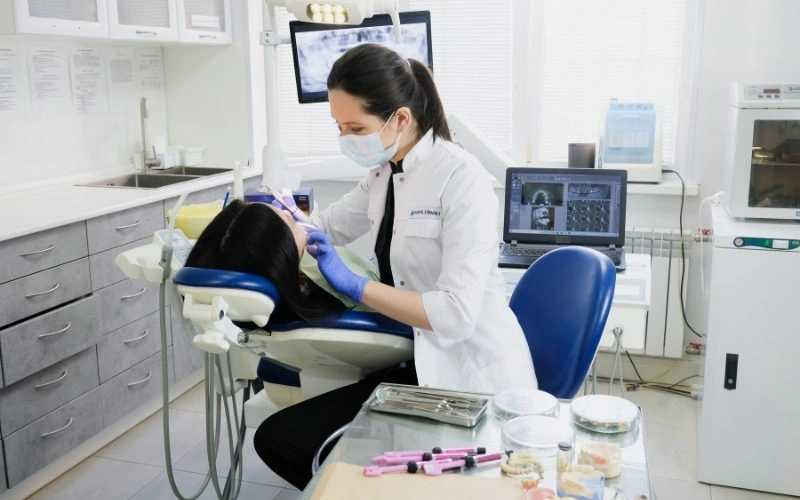
 and (max-width: 480px) 480px, (min-width: 481px) 800px, 100vw” data-lazy-src=”https://dentalcouture.com.au/wp-content/uploads/2025/07/Dental-Anxiety-What-To-Do-About-It-In-Dental-Couture-At-Melbourne-North-West.jpg” /><noscript><img decoding= "Dental Anxiety What To Do About It In Dental Couture At Melbourne North West")
The lucky exceptions find it a neutral, even a pleasant experience. Generally, they’re people with really good oral health. The classic chicken or the egg paradox comes to mind; overlaid with the nature or nurture one. To be genetically blessed with strong straight teeth, robust gingiva and reared in a home where oral health is valued, is a situation where fortune doesn’t have to favour the brave: a Mensa member doesn’t sweat the Atlantic weekly quiz.
Whatever the answer to maintaining a thrill, rather than spine-ratcheting chill in the dentist’s chair is far from simple.
Those with dental anxiety and its overwhelming expectations of pain and suffering, delay or avoid check-ups and treatments. Sub-optimal, and declining oral health is the outcome of this neuro-rift that keeps on giving all the stuff you really, really don’t want. Dental anxiety and its bigger, uglier cousin dental phobia make it not only harder to even get to the dentist, they make the dentist’s job harder and more stressful too.
Imagine dealing with a small animal that needs your help and it’s too terrified to let you.
For more than two decades, psychology and behavioural sciences have found relevance in dental education and clinical practice, and they continue to expand patient calmness and relaxation beyond analgesics and anaesthetics.
Dental anxiety has a range of causes. It’s not necessarily the viscous residue of past traumatic experience related to dental or medical procedures. It can manifest from anything that imprints as a perceived threat; meaning the management of it is far from a simple matter of identifying the ideal sedative. Without proper assessment of the anxiety, good communication between patient and clinician isn’t established and the ability to exchange information that can reduce the fear isn’t strong. This important dynamic alleviates suffering, mistrust, and emergency situations.
From wherever the fear initiated, it surfaces because a sense of powerlessness and the perception of limited options remains. Nurturing a patient-centric approach is a core principle of dentistry. Hippocrates’ philosophy that “It is more important to know what sort of person has a disease than to know what sort of disease a person has” is very much the mainstay of the profession.
Along with creating a calm environment, and having access to gentler tools and choices for appropriate sedation, dentists and their teams are trained in relaxation strategies and techniques to help patients receive the care they need. To successfully complete treatments for people who have less and less difficulty being in the chair because their anxiety is addressed, is a triumph for all involved.
The most crucial aspect of what to do about dental anxiety is to find yourself the right dentist.
One with communication skills that fit. It’s fine to book an initial consultation for that purpose, and recommendations from friends and family are a good start. There’s no shame in fear; it is what it is. Acknowledging, and discussing all of it with the dentist you trust and feel most comfortable with, is really all you have to do. Don’t make it harder for yourself: just do that, and take on their expert suggestions and advices.
You’ve spent a long time giving into the fear – every nudge you give it to get out of the way is a victory. None are small. They’re all giant steps of enormous courage. And the prize for that is not only a beautiful smile from having such good oral health, but a sense of achievement that 189,819 letters barely describe.